I really enjoy teaching watercolor classes, especially to those beginners who have decided to jump in and try to learn the media.Most of my students are retirees since we live in the Rio Grande Valley in Texas. So many have always wanted to paint and to be creative but have been afraid to try anything new. Suddenly in later years, they throw aside their fears of being rejected and decide that it is now or never to pursue their desire to paint. The main obstacle is to get over the fear of rejection, a fear that is usually instilled in all of us from childhood. I try to instill the thrill of the process of painting rather than the final product of their efforts. Most start out wanting to copy a photo or a picture to perfection and are dissappointed they are unable to do so and then they are discouraged. As teachers, I feel we must encourage the students differences and let them know that art is unique to each person. When we visit art museums we notice that most of the art is a personal statement of the individual artist, not a perfect copy of the subject. We cna teach the basic techniques, color theory and composition then let the student have fun exploring the media. Comments welcome
Saturday, January 19, 2008
I really enjoy teaching watercolor classes, especially to those beginners who have decided to jump in and try to learn the media.Most of my students are retirees since we live in the Rio Grande Valley in Texas. So many have always wanted to paint and to be creative but have been afraid to try anything new. Suddenly in later years, they throw aside their fears of being rejected and decide that it is now or never to pursue their desire to paint. The main obstacle is to get over the fear of rejection, a fear that is usually instilled in all of us from childhood. I try to instill the thrill of the process of painting rather than the final product of their efforts. Most start out wanting to copy a photo or a picture to perfection and are dissappointed they are unable to do so and then they are discouraged. As teachers, I feel we must encourage the students differences and let them know that art is unique to each person. When we visit art museums we notice that most of the art is a personal statement of the individual artist, not a perfect copy of the subject. We cna teach the basic techniques, color theory and composition then let the student have fun exploring the media. Comments welcome

Monday, March 27, 2006
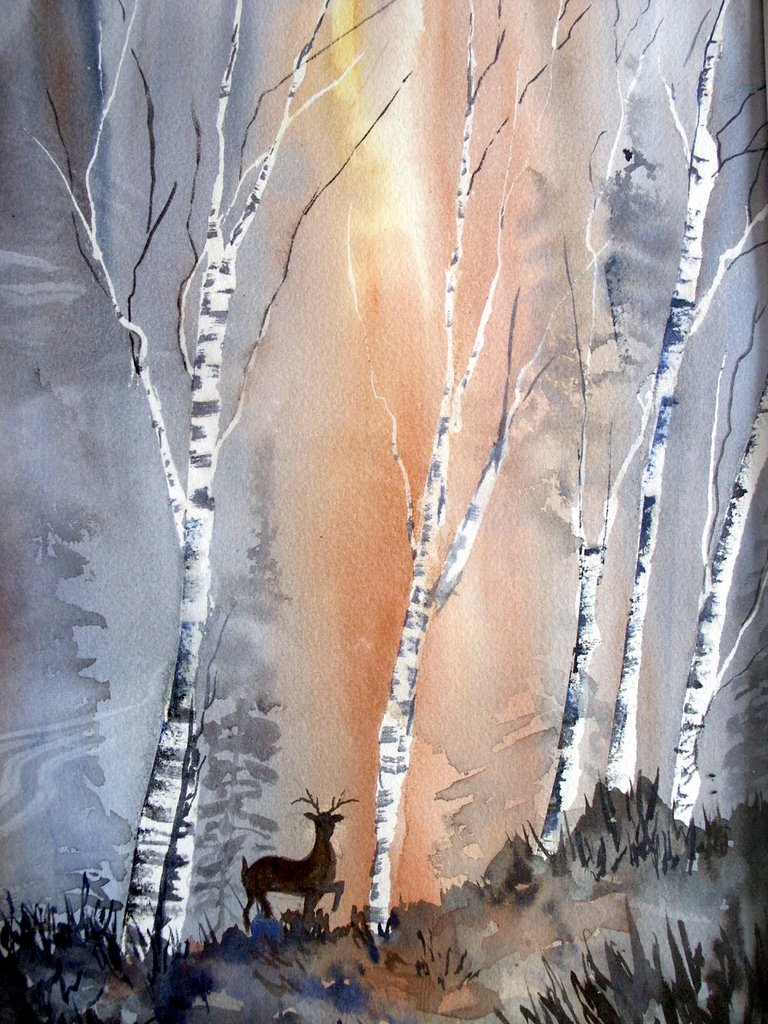
Just finished taking a watercolor workshop with local Brownsville artist, Zito Kare at the Brownsville Museum of Fine Art. Zito gave a oil painting workshop two weeks ago and was the judge of this years International Art Exhibit.
Workshops are not the place to do your best paintings but they are the place to observe and learn new techniques no matter how long one has been an artist. A good workshop instructor will introduce his methods of painting by demonstrations and helping individual participants. When taking a workshop, the student should be willing to "stretch" out of their own comfort zone and try new methods and techniques that are being presented by the instructor. Once back in your own studio you may or may not incorporate all of these techniques into your style but you should avoid attempting to change your own style completely by trying to mimic the instructor's style completely.
I have attended numerous workshops over the past 20 years and each one has added to my artistic skills and techniques but I feel that I have developed my own unique style of presenting my artistic visions.
Zito Kare's workshop reinforced the beauty of mingling the watercolor paints directly on the paper rather than mixing colors on the palette. He also showed that beautiful colors could be obtained with a minimal number of paints on his palette. He uses Ultramarine Blue, cerulean Blue, Paynes Grey, Cadiminum Red and Raw Sienna as his basic colors in almost all of his demonstrations. These are hues that I had rarely used on my own palette. He mixes beautiful greens without using a tube of green paint. He also mixes great dark colors without using staining paints.
If you have an opportunity to take a workshop with Zito, I recommend you do so.
Thursday, March 16, 2006
Wednesday, March 01, 2006
Attempting realistic Painting on Yupo Paper
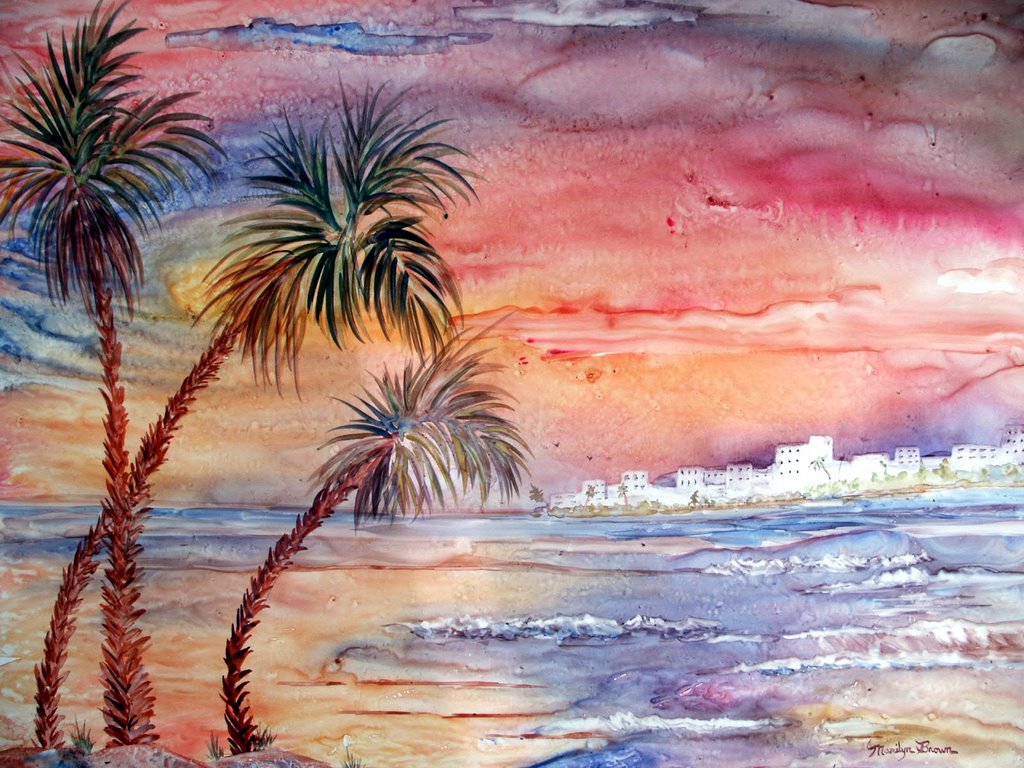
This week I have been attempting more realistic watercolor paintings on Yupo paper after viewing a video by George James using this synthetic paper. I find if difficult to try to layer another color over the previous watercolor even if the paint is dry. With any pressure at all, the underlying paint will lift off. He made it seem easy to do in his video so I will keep trying to glaze paint over paint and maybe I will master the technique eventually. The great advantage of Yupo is being able to totally lift off the paints back to the white of the paper. This painting of Laguna Madre with buildings of Padre Island in the background was a result of lifting and removing a mountain shape behind the water and turning it into a row of buildings.
In the past I have used heavy vinyl to move the watercolor paints into patterns rather than using a brush. I hope that any of you reading this post will comment on your use of Yupo paper and techniques you find successful.
This week I have been attempting more realistic watercolor paintings on Yupo paper after viewing a video by George James using this synthetic paper. I find if difficult to try to layer another color over the previous watercolor even if the paint is dry. With any pressure at all, the underlying paint will lift off. He made it seem easy to do in his video so I will keep trying to glaze paint over paint and maybe I will master the technique eventually. The great advantage of Yupo is being able to totally lift off the paints back to the white of the paper. This painting of Laguna Madre with buildings of Padre Island in the background was a result of lifting and removing a mountain shape behind the water and turning it into a row of buildings.
In the past I have used heavy vinyl to move the watercolor paints into patterns rather than using a brush. I hope that any of you reading this post will comment on your use of Yupo paper and techniques you find successful.
Sunday, February 19, 2006
Watercolor controls my destiny as a watercolor artist. You can understand color theory, elements and principles of design and still fail as a watercolor artist unless you understand the fickle nature of water. Water can make you a God-or it can reduce you to tears-depending on how much you know of its nature and its reaction with pigments and paper. I have been painting with watercolor for 15 years and I am still amazed at what those little water molecules can do. A lot of water and a small amount of pigment can blossom into something beyond comprehension. The correct touch with pigment and water is a "happening". The same thing with the wrong pigment and water combination and be a disaster. Judging what combination in what circumstance is critical.
I love riding the edge between right and wrong. Many times I haven't a clue where I want to go, but I am always excited by the prospect of what may happen, good or bad. It kills me when it goes bad but when it works right, it is something to behold! It seems so easy when it works well, just a flick of pigment and you watch things happen that you couldn't have believed possible in your dreams.
If you want to be a watercolor artist, you will have to understand water. You will live and die by the water. The elements and principles of design and color theory will serve you well, but when you are working in WATERcolor--it is the water that rules!!
I love riding the edge between right and wrong. Many times I haven't a clue where I want to go, but I am always excited by the prospect of what may happen, good or bad. It kills me when it goes bad but when it works right, it is something to behold! It seems so easy when it works well, just a flick of pigment and you watch things happen that you couldn't have believed possible in your dreams.
If you want to be a watercolor artist, you will have to understand water. You will live and die by the water. The elements and principles of design and color theory will serve you well, but when you are working in WATERcolor--it is the water that rules!!
Friday, February 10, 2006
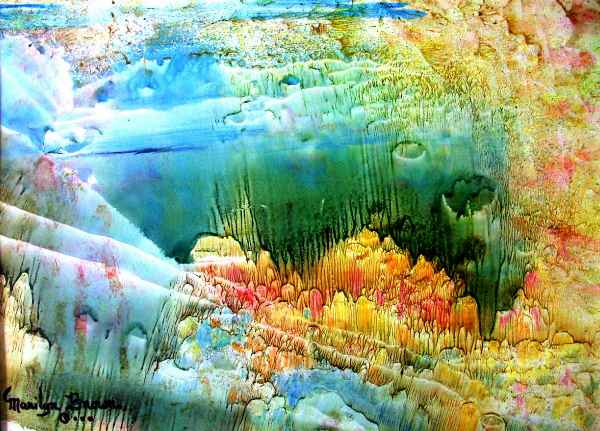
This is a watercolor painting on Yupo paper., a fairly new synthetic paper that is very slick and will not absorb paint into the paper fibers. . I use a technique with heavy vinyl to move and manipulate the paint on the paper. Once I get the design and patterns that I am happy with from the lift, I can use a brush to move the paint into different areas or to remove the paint where I want whites to reappear. It is very spontaneous and the results can be surprisingly good (or bad!). The advantage is that most paints if non-staining can be washed off the paper and one can start all over. More Yupo paintings can be viewed on m website.
Thursday, February 09, 2006
Wednesday, February 08, 2006
Why I Love Watercolors
The main reason that I fell in love with the watercolor media was its "happy accidents", the wonderful things that happen with water and paints that are incidental and not always in control of the artist. When I mingle paints on a wet surface and wait for the magic to happen is the beauty of this media. If an artist wants to always be in total control it might be better to work in a different media such as oil. acrylic or pastels although I do use acrylic with a lot of water in thin washes to get the spontaneous feel that I get with watercolor. It is the process of painting that turns me on rather than the product of the painting. Some of my best paintings are spontaneous and the final subject of the painting speaks to me late in the painting. I might plan what colors I use to begin a painting rather than what subject I am going to paint. After the colors mingle on the wet paper I enjoy finding the subject within this underpainting and bringing the subject forward with negative painting behind shapes that I find. This really lets the painting do the talking to the artist rather than the artist trying to take total control.I welcome comments from other watercolor artists about their feelings as they use this media.
Monday, February 06, 2006
watercolors Papers
watercolors papers come in many surface textures, rough, cold-pressed and hot pressed. The most common used are cold press 140 lb. and 300lb. The papers are designated in pounds according to the thickness of the the total weight of a ream of the paper. The ususal measurement of watercolor paper is 22 "x30" when purchased in sheets. You can buy pads or blocks of papers but this is more expensive per square inch of paper.
There are many good brands such as Arches, Strathmore, Winsor and Newton, Lanaquarelle, and Fabriano. The paper most preferred by American watercolor artists is Aches 140 cold press. This paper is somewhat off white in color. Winsor and Newton papers are also widely used and is more brilliant white than Arches.
Using good paper is a must, even for beginners. It will not turn yellow over the years and in is tougher than inexpensive paper. It will allow you to remove mistakes by scrubbing off unwanted paint marks, sponging off the surfaces , and enabling you to dry the paper with a hair dryer without damaging the paper.
Some watercolor artists feel you must soak the paper and then tape or staple it to a board to dry before beginning to paint. Others just start painting! This is a personal preference, whatever seems to work best for you. Personally, I don't soak my papers as it seems to remove too much of the original sizing.
Send me your comments and questions about watercolor papers
watercolors papers come in many surface textures, rough, cold-pressed and hot pressed. The most common used are cold press 140 lb. and 300lb. The papers are designated in pounds according to the thickness of the the total weight of a ream of the paper. The ususal measurement of watercolor paper is 22 "x30" when purchased in sheets. You can buy pads or blocks of papers but this is more expensive per square inch of paper.
There are many good brands such as Arches, Strathmore, Winsor and Newton, Lanaquarelle, and Fabriano. The paper most preferred by American watercolor artists is Aches 140 cold press. This paper is somewhat off white in color. Winsor and Newton papers are also widely used and is more brilliant white than Arches.
Using good paper is a must, even for beginners. It will not turn yellow over the years and in is tougher than inexpensive paper. It will allow you to remove mistakes by scrubbing off unwanted paint marks, sponging off the surfaces , and enabling you to dry the paper with a hair dryer without damaging the paper.
Some watercolor artists feel you must soak the paper and then tape or staple it to a board to dry before beginning to paint. Others just start painting! This is a personal preference, whatever seems to work best for you. Personally, I don't soak my papers as it seems to remove too much of the original sizing.
Send me your comments and questions about watercolor papers
Sunday, February 05, 2006
Watercolor Column
Paints
Adapted from article by Ken Austin,
People who don’t paint in watercolor usually think it is the most difficult medium. These people are saying the technique is difficult. Creating is difficult but not the technique. The technique is learnable. Watercolor is not any harder than any other technique-dependent medium. But to work in watercolor you must be FEARLESS. If you use it like a wimp, your work will look wimpy. If you paint below your skill level, it looks amateurish. This shows more in watercolor than in most other mediums. But strength comes with assurance and assurance comes with experience. If you do meet artists in other mediums who think watercolor is tough, by all means agree with them. It will make our watercolors sell for more!
Watercolor paints come in several forms and many qualities. They range from those which won’t mix and will fade quickly to those that paint like a dream and last for hundreds of years. The main differences are two; the quality of the craftsmanship in the paint’s manufacturer and the cost. Many very good brands are on the market. Most of these come in two levels of quality: artist and student. The main differences to you are in the cost, the number of colors available in each type and how the paint acts as you apply it. Artist quality colors mix easily, maintain color evenly, go on the paper easily and are of reliable sameness from tube to tube. Student quality paints are made from the same ingredients but usually contain more filler or binding agent and seem to dry out in the tubes more quickly. They are much less costly. (Avoid using inexpensive watercolor in pans like they do in elementary school art classes, they are heavy in binders and white paint mixtures, therefore very opaque).
Some of the better brands of watercolor paints are, Winsor and
Then to make things even more complicated, watercolors come in two types: transparent and opaque. Transparent is what we refer to in most cases. Opaque include gouache and tempera. Many opaque watercolors have the same names as the transparent ones and are made by the same companies so be sure you are buying what you intend to.
Colors also differ in their ability to stand light. Those which will fade are called “fugitive” colors. In general cheaper colors will fade faster, do not handle as well, and don't have the better intensity of color when you mix them.
In addition, colors can be staining or non-staining, more transparent or more opaque depending on how they are made, as well as granular or non-granular.
When you buy your paints you should have the true color as well as warms and cools of that color. You can start with a basic palette of the three primary colors, red, blue and yellow plus their warm and cool partners.
Paints contain natural organic materials. Therefore, they are susceptible to mold, especially in a warm, humid climate. You can let your paints dry on your palette and when ready to use them again give them a light spray of water. If you do see mold, remove the paint from the palette, throw them away, clean the palette and rinse it with Lysol. Don’t use them or your paintings may develop a strange growth on the paper when matted under glass.
Finally, be careful. Paint is not necessarily healthful. Don’t stick paint-laden brushes in you mouth or in your coffee! Don’t eat a sandwich or a cookie with your fingers loaded with fresh paint. In recent years, manufacturers have reduced the use of many toxic chemicals and minerals in their paints but you still need to be careful.
Subscribe to:
Posts (Atom)